Showing posts with label Gardening Books. Show all posts

Sunday, February 17, 2008

Four things I hate about container gardening books

I have two types of gardening books on my bookshelves : the first are about gardening, the second are about container gardening.

The container gardening books have a different emphasis from the others. They're not so much about how to grow things, as what plants to combine to produce the most attractive containers. And at times they drive me mad. Here's why ...

1. The presumption that container gardening means patio gardening, or at least that you have a large terrace. If you can use enormous containers, raised beds and so on, its a whole different ball game from balcony gardening, and much of what you need to know is no different from gardening with a garden. The book often looks great, but relegates small container gardening to hardly more than a chapter.

2. The perfect pictures. Five different types of plant in the same container, all in flower and at their best, and all exactly complementary heights and lengths at exactly the same time. Yeah, yeah. Buy them from the garden centre, give them a week to settle and they'll be like that - for another week. But then one will shoot up, another will get attacked by pests, and a third will stop flowering. And the container will spend the rest of the summer looking tatty.

3. The one-sided pictures. The most difficult thing about balcony gardening is that all the light comes from one direction. So the plants lean towards it, away from the house, and the container ends up lop-sided with the plants trailing over the balcony railings away from you. All you get to see from your living room are the backs of flowers and leaves leaning away. And tall plants end up looking like the leaning tower of Pisa. Smaller containers can be turned regularly, but that doesn't help with the large fixed ones. Look at the one in the photo for example - super. But what's it like from the other side?

4. The perfect colour schemes, achieved only by going out to buy an exact variety of a plant. Phyllitis scolopendrium "Cristatum" - whaaat ? Here I'd be lucky if I could get the plant, let alone a specific variety. I have sometimes thought of going to our local garden centre with a list and saying "I'm looking for these." I suspect the reply would be the Italian equivalent of "What about some nice pelargoniums, luv?"

OK, OK - I'm just envious because my containers never look as good as the ones in the books. But that doesn't stop me yanking them out every spring, poring over the pictures and trying again. And buying more. Maybe this year ...

Wednesday, January 24, 2007

Curious Incidents ...

If you’re looking for something different to read, try Curious Incidents in the Garden at Night-Time : The Fantastic Story of the Disappearing Night by Allan Shepherd. Published by the Centre for Alternative Technology Publications, it starts off as an extended short story – the story of an amateur naturalist who is passionate about moths, and who has designed his garden to contain night-scented plants which will attract them. Each night he records the species he captures, (he doesn’t kill them, just collects and records the species then lets them go), and notes which ones are slowly disappearing due to global warming and other factors. The blurb on the cover uses words like magical, eloquent and beautifully written and I’d add beautifully illustrated and designed. At the end of the book Shepherd lists his inspirations, which are The Curious Incident of the Dog at Night-time, The Little Prince, To Kill a Mockingbird, Walden and the film It’s a Wonderful Life. If you know these and can imagine them all rolled up into one book, that’s what this book is. And like these books, the overall feeling is positive. He’s talking about the extinction of thousands of species, but the end of the story suggests that there is, after all, hope.

The unusual part of the book, though, is not the story at all. The moth collector keeps a notebook on ecology, called the Memory Book. The second part of Curious Incidents are extracts from the Memory Book, which is partially on gardening – in particular creating a garden to attract wildlife in general and moths in particular – partially on evolution, global warming, and partially on the moth collector’s own memories (though these extracts are included in the first half rather than the second). It includes extracts from other writers, results of the moth collector’s own research, web references, and lovely illustrations.

I received the book as a present, and it couldn’t have been better chosen - thank you, Alison. You can find it on Amazon, along with some other of Shepherd's books.
I think The Little Book of Garden Villains looks quite fun …


Saturday, September 30, 2006

Winter Book Club

You may already have seen that Carol of May Dreams Garden (see the link in the sidebar) has proposed organising a book club for the winter months. The idea is that people should suggest books they’ve enjoyed which other people could read and then comment on.

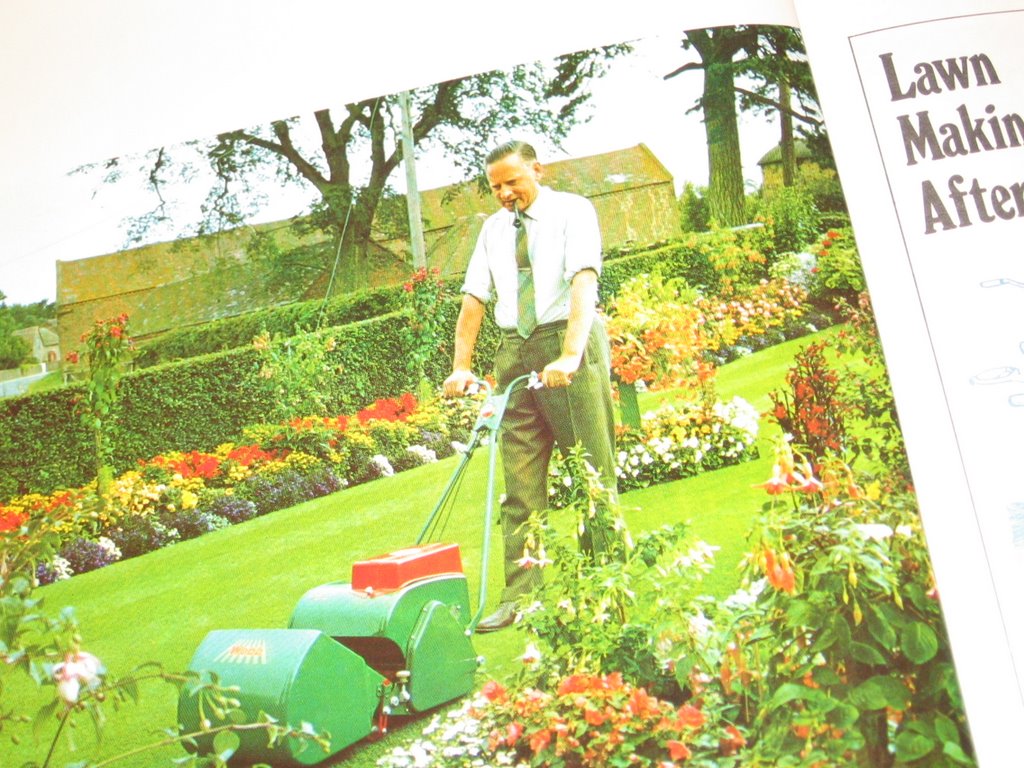
I immediately sat down to write a list – and found I couldn’t. For obvious reasons, Carol’s two criteria are that the books should be still in print and written in English – and most of mine aren’t. If I say that one of the books I refer to most was written in 1969 by Percy Thrower , you’ll get the general idea (no, I wasn’t gardening then – I inherited it. But that’s for another post). The wonderful thing about gardening books is that they don't go out of date - the new ones may describe new varieties and have new ideas, but the old ideas are still the basic ones. The only thing about Percy that drives me mad is that he clearly believes he's writing for a male audience. A woman is simply the nuisance in the house who demands that certain plants are grown to provide cut flowers. But I'll forgive him. (And don't you love the shirt and tie for cutting the lawn?)

Back to the book club. As I couldn't recommend anything off my shelves, I decided to write a wish list instead, and spent half an hour surfing Guardian Unlimited’s gardening book section. I ended up with a list far too long to post, but I’ve whittled it down and you’ll find it below. I have no idea if these books are really good or not, but they look interesting and I wouldn’t say no to finding them under the tree on Christmas morning (just in case my husband happens to be reading this) :

Michael Pollan - The Botany of Desire: A Plant's-eye View of the World, Bloomsbury Publishing
Christoper Lloyd and Graham Rice - Garden Flowers from Seed, Penguin (UK) Timber Press (USA)
Alan TitchmarshAlan Titchmarsh, the Gardener's Year, BBC Books (or anything else by Alan Titchmarsh, come to that).
Charles Chesshire- Japanese Gardening, Aquamarine
Steven B Carroll - Ecology for Gardeners, Timber Press - this is available for limited preview on Google.
Quite a lot of people have already submitted lists, and all the titles look interesting. I'm looking forward to seeing which ones are chosen. When are we going to start, Carol?

Tuesday, September 26, 2006

Reusing and Recycling

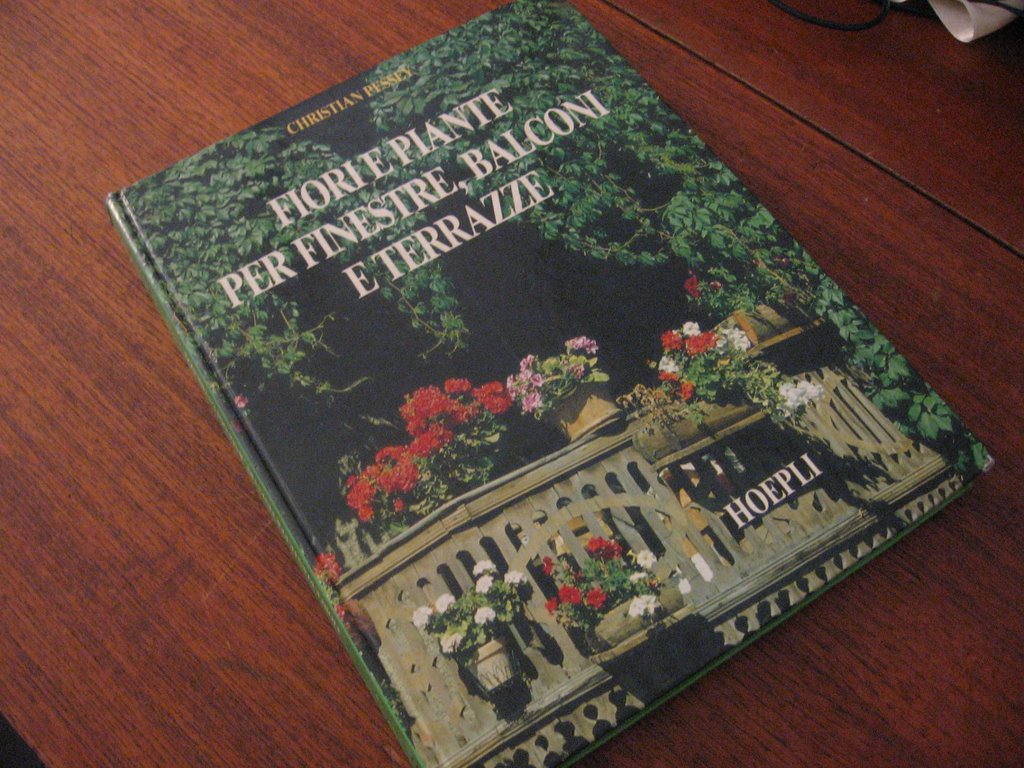
Our local library has just closed for three months, for building renovation work, so I took advantage of the fact that we were able to take out more books than usual for a longer period and got several large reference books – the sort that you want to dip into a bit at a time, rather than read straight through. One of the books I took out was by Christian Pessey. The original was in French, but an English translation of the Italian title would be Flowers and Plants for Windows, Balconies and Terraces. Reading it got me thinking about recycling.

In Milan, household waste has to be separated – paper, glass, plastic and aluminium all go into separate containers from “wet” waste, and are recycled. Which would seem great for the environment. But even recycling has its critics – the amount of energy used in transporting and reprocessing the waste creates pollution, as may the chemicals involved in the reprocessing itself. For the pros and cons, click
here and here.

Another site, and I’m afraid I’ve lost the link, suggested that a balanced approach was to follow the Five Rs : Reduce the amount of plastic etc used; Reuse things wherever possible; Recycle things which really have to be thrown away; Reject items using excessive and unnecessary packaging; and React – let manufacturers and shop-owners etc know how you feel.

Plessey’s book was interesting from the re-use point of view. Although he didn’t explicitly mention environmental issues, he suggested various ways that plastic packaging could be used in gardening rather than buying new stuff. Some of his ideas were not new – for example, using yoghurt pots for seedlings instead of buying more plastic pots (though even there it had never occurred to me to use a match or red hot needle to make the drainage holes – I tried it out with a candle flame and it was much easier than my usual clumsy attempts with a skewer). But others, though simple, I’d never thought of – for example cutting off plastic bottle bottoms to make mini-cloches to fit over pots with cuttings or seedlings.


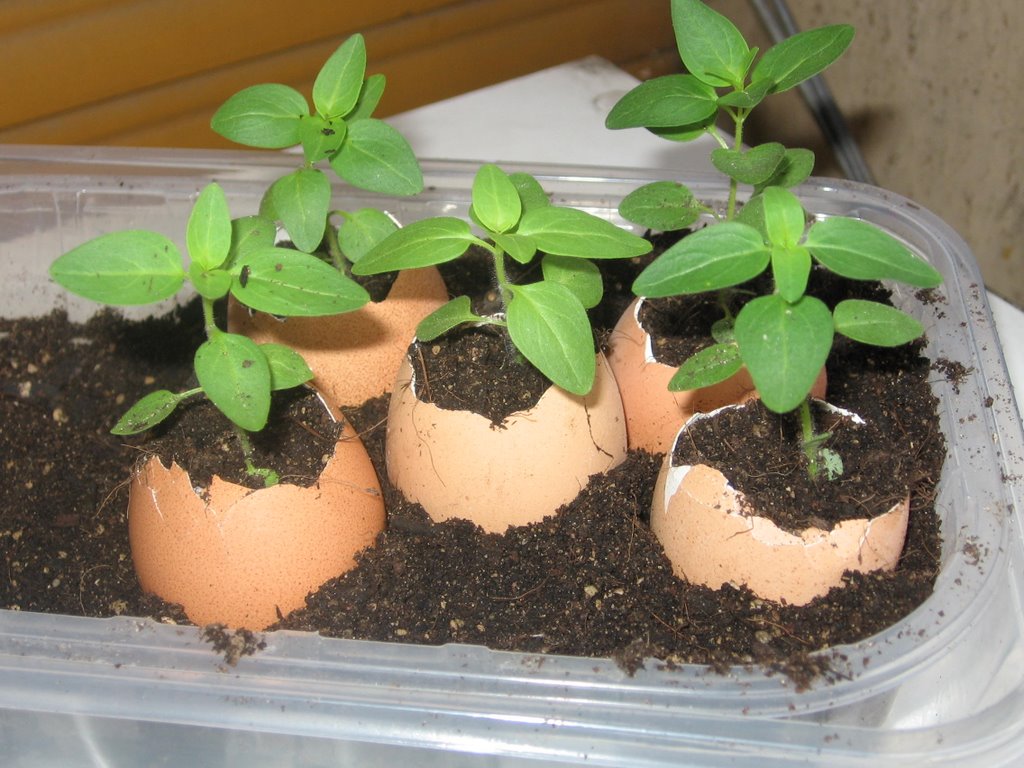
But my favourite idea was that of using the shells of boiled eggs (with a hole pierced in the bottom for drainage) instead of small plastic or peat pots. (For reasons for avoiding peat click here ). They have the same advantage as peat pots in that the whole “container” can be transferred to the final planting position, without disturbing the roots of the young plant, and the roots will simply grow through the shell, acquiring nutrients on the way. I presume this means a lot of calcium, so it’s probably to be avoided for lime-hating plants, but it would be great for things like zinnias which love lime.

I’m afraid I’ve gone a bit overboard on this one though and will have to calm down. I suspect my family are likely to revolt if they see another egg within the next fortnight…