Showing posts with label Mirabilis Jalapa. Show all posts

Tuesday, August 24, 2010

It's been a long, hot summer...


It's been a long summer. July was unbearably hot and humid - well, unbearable for me anyway. I have naturally low blood pressure, and in the summer here it nose-dives to somewhere around my ankles. I just wilt. My husband, who has the opposite problem, suddenly perks up. Ah well, you can't please all of the people all of the time...

I finally managed to escape to England for a fortnight, hoping for a cooler climate and expecting to find the garden overgrown again.


But no. The heat they'd had there too meant that the grass had hardly grown and the weeds were nothing like when I'd gone back in April. There was still plenty to do - it took me a day's work to trim the hedge, and there's still borage to fight against - but even there I think I'm winning. Almost all of it seemed to be this year's growth, and relatively easy to pull up. Still the odd plant growing off long, thick taproots, but after two years fighting, I'm gradually getting somewhere. I've managed to stop it going to seed this year too, which will help - though I have few illusions. There must be enough seeds scattered around from past years to last for eternity. But all in all it wasn't bad. It's not going to make garden of the year, but neither does it look totally neglected any more. The hebe was wonderful - and, I'm pleased to say, full of butterflies - and the hydrangeas were as wonderful as ever.


Some of the things I'd planted last year and this spring were in bloom too - the lavender is doing really well, some of the nasturtium seeds I'd scattered had come up, and there were marigolds and petunias blooming their heads off all over the place. I even managed to harvest a handful of runner beans to bring back. Not bad for a garden left almost entirely to its own devices.


Back on the balcony in Milan though, its been a different story. Hardly anything seems to have done well this year, no matter how much tender loving care it's received. The pelargoniums ar fine - there's still been no sign of the Geranium Bronze Butterfly this year - and the plumbago has been pretty, but there have been years when we've had far more flowers and much larger blooms ....


And as for the rest... Even the Four o'clocks (Mirabilis Jalapa) have been sick and weedy, and they're usually a stalwart. I noticed something was wrong quite early on. I'd planted a lot of seeds, but very few came up - unusual for a plant which tends to be invasive. And those which did looked thin and weedy. And then, a couple of weeks ago I noticed that they'd been attacked by red spider mite - unheard of. If there's a plant which I've always said didn't succumb to pests, is was the Four o'clocks - the main reason I grow them is because they're still there when everything else has been killed off. They're currently still hanging on, but by now they should be in flower, and there's not so much as a bud.


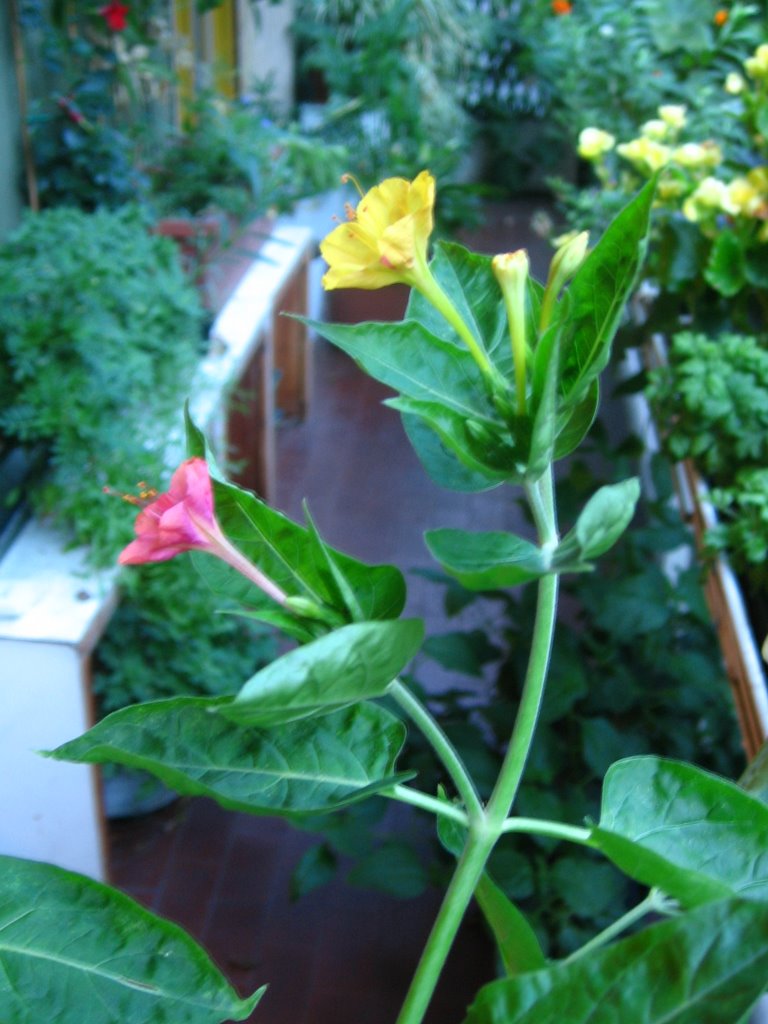
The seeds I'd planted were some that I'd collected last summer. They came from vigorous, healthy plants and I was expecting a great display. It was a lemony-yellow variety which I'd never seen before, and very attractive - much more so that the pinky ones I've grown in the past. I didn't plant any of those this year, and now regret it - because the only plant I do have in flower is one which self-seeded from last year's plants. And yes, he's doing well - but looking a bit sad all on his own in his pot. Four o'clocks really need to be planted in clumps to be really impressive.

After the first week or so, August cooled down and most days we now have pleasantly warm temperatures in the mid-twenties, going up to twenty nine or thirty occasionally, but never over. Like the balcony, I'm slowly feeling less wilted and getting back to real life. And to work, and to blogging. I've just not had the energy for the last couple of months. I have gone on taking photos though, and if I can claw back enough enthusiasm to get them written, posts should be appearing regularly from now on. Fingers crossed ....


Sunday, August 10, 2008

Four O'Clock Follow Up

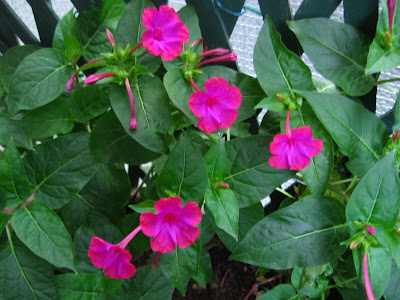
On Gardeners Bloom Day last month, I wrote about mirabilis jalapa, the Four O'Clock plant. I said that the plants I'd grown from tubers were blooming, but that all they'd given me were either red or pink flowers - a bit disappointing given that the plant can have a variety of colours, the flowers can be bi-coloured, and that sometimes you'll even get two different colours on the same plant.


But I also had some others coming on which I'd started from seed, and they're now blooming. And lo and behold one of them is producing a mix of yellow and pink flowers, some of them with rather natty stripey sections.

As I was moving them around last week I clumsily broke off a large chunk of one of them. It was full of buds, so I thought I'd stick it in a jar of water to see if the flowers would open anyway. I then forgot about it till yesterday, only to find that within the week it had put out roots. This has to be the easiest plant in the world to propagate ...

Friday, July 18, 2008

Gardener's Bloom Day : Mirabilis Jalapa


This month's GBD post (a bit late - sorry) focuses on a plant I've grown for the last three years, and which has become a firm favourite - Mirabilis Jalapa. Originally from South America, it's been known in Europe for the last five hundred years. It's a plant which has a thousand and one common names - you probably know it as the Four o'clock plant, but it's also commonly called Beauty of the night or Marvel of Peru amongst other things in English, while the Chinese apparently call it the Rice Boiling Plant or Shower Flower, and in Hong Kong it's Purple Jasmine.


It's a sun loving plant which can't take cold temperatures, and is therefore often grown as an annual. However, although it will die down in the autumn, the tubers can be lifted and stored, much like dahlias, or if it's not too cold just left where they are. This year I grew some plants from last year's tubers and others from seed, starting both off at about the same time. The tubers have come on far faster and are now in flower, while the others are still fairly small. If you do plant from seed, try soaking the seeds for a day or so before you put them in. They germinate far faster.

The plants grow to about 3ft, and don't seem to have any particular requirements as far as soil is concerned, though one site I found suggested they like slightly alkaline conditions. That would explain why they do so well for me, as the water here is very hard, and I have problems with lime-hating plants. They need a lot of water, and wilt immediately if they get dry. However, despite looking very dramatic, they do pick up again well once they've had a good soak.

The plants put out copious quantities of flowers, which can have a wide range of colours and are sometimes variegated. They're set off well by the bright green leaves which are half the attraction of the plant. The flowers are well known for the fact that they don't open till the evening - hence many of their names - but the other intriguing thing about them is that they will often put out different coloured flowers on the same plant. It hasn't happened yet this year, but here's a photo of one I had two years ago.


The flowers only last a day, but are replaced by others immediately. Large seeds then form, at first greeny yellow but maturing to black, again providing an attractive contrast with the foliage.

In a garden the plant will happily self seed, but if you don't want it to it's easy to collect the seeds for storage (if time consuming because of the quantities). If you have small children around, however, beware. The seeds, which look temptingly like little sweets, are poisonous - as are other parts of the plant.


Being poisonous hasn't stopped it having a long history as a medicinal plant however, as it also has antifungal and antiviral properties (don't try this at home). Various chemical compounds extracted from the plant are now used commercially as the basis of products combatting viruses in crops such as corn and potatoes.


This probably explains why they are one of the few plants that I've never seen affected by pests and diseases. While all else is succumbing to the red spider mite or powdery mildew, the Four o'clocks plough on bright and healthy. Which for me guarantees their place on the balcony any year.


Explore some more ....

Raintree Nutrition

Rainyside Gardeners


Monday, April 7, 2008

Annuals??


One of the things which I find most misleading about many gardening books, websites and seed packets is the way they class as "annuals" plants which just aren't. Alyssum and antirrhinums for example. If you're very lucky you might see an expression "usually grown as annuals" or which is always a give-away that they're actually perennials, or the more explicit "beautiful annual (strictly perennial) flowers", but there's rarely an explanation and often no indication at all. For the beginner it's confusing, and may well lead to plants being thrown away which would continue to do well the next year if left to their own devices.

The two main reasons given for treating perennials as annuals are usually the fact that they won't survive low winter temperatures, and that they won't flower as well the next year, but neither of these are necessarily true.

Temperature of course depends largely on where you live, and if you have below freezing conditions for most of the winter, well then annuals they probably are. But if you are in a milder or more sheltered spot, wait till spring and see what you manage to bring through.


As for getting fewer flowers, I've found quite the opposite. I've got several so called annuals on the balcony which are now into their second or third year and are bigger, stronger and giving more flowers than ever before. Here for example is my "annual" alyssum. As you can see from the stem, it's no young plant. It's certainly in its third, and possibly fourth year. The antirrhinums in the first photo are the same, and are covered with buds. They're going to give far longer, stronger stems of flowers this year than they ever have before.


I did cover the alyssum in the coldest parts of the year, as I also did for the marigolds and the surfinias. The marigolds eventually gave up, so maybe they really are annuals, but the surfinias certainly aren't. This year I was misled by a mild spell back in February, uncovered them, and lost them when the temperature suddenly dropped overnight. But last year, the overwintered surfinias from the previous year flowered all summer.

Obviously the temperatures here aren't that cold. It rarely drops below about -2° or -3° centigrade, and the balcony provides a sheltered environment where the plants can snuggle against the walls of the house for warmth. But the antirrhinums were uncovered on the edge of the balcony all winter, and were even
snowed on with no detrimental effects at all.


Another plant which I'd always seen described on seed packets as an annual (now why would seed producers want you to believe plants are annuals when they're not , I wonder?) is Mirabilis jalapa. So when mine died down over the winter, I didn't think twice about it. But being too lazy to go out and throw it away in the cold, it stayed there till about six weeks ago. And when I emptied the containers I found thick tuberous roots. Not the usual sign of an annual. So I stuck them back in the pot to see what would happen. And lo and behold .....


Will I get the same number of flowers this year as last? I'll have to wait and see. If not, I'll go back to treating it as an annual and growing from seed each year. But it's going to be interesting finding out.

So don't give up on plants just because of the description they're given. If you think you can bring them through the winter for a second year, try it. You may end up with a better show than you got the first year.


Friday, September 14, 2007

September Blooms

It's Gardener's Bloom Day again (it seems to come around awfully quickly). So here's what's blooming on the balcony this month ....


Surfinia. I'm proud of these because they're the ones I grew from seed this spring. It took them a while to get going, but now there's a profusion of blooms. We're having a very hot September - although the mornings can be chilly, it's still up in the eighties by the afternoon. So I hope they'll go on for a while. Only the white ones made it, although the seeds were mixed white and purple.


Mirabilis Jalapa - the Four O'Clock Plant, Beauty of the Night, or whatever it's called round your way. Like the surfinia, these came from seeds saved from last year's plants. They've bloomed much later this year than last, and I haven't got the same profusion of blooms that I had before. But I'm enjoying them.


Pelargoniums - red, salmon and white. My salmon pelargonium has now bloomed continuously for eighteen months. Will it take this winter off, I wonder?


Periwinkle. Useful on the balcony because they don't get ravaged by pests and diseases, and are good for filling gaps in containers if other stuff dies off. And talking of pests ...


The Antirrhinums seem to have got their second wind and are blooming again. But so have the caterpillars. I didn't actually notice we had visitors until I printed out the photo.


Campanula - OK, this one's a cheat. I saw it in our local supermarket last Saturday and couldn't resist - it's the same variety as the one blooming in my London garden. Call it nostalgia.

Sunday, August 13, 2006

Mirabilis Jalapa


I’ve grown Mirabilis jalapa (Beauty of the Night or The 4 o’clock Flower) for the first time this year and it’s recently started flowering. I’ve been a bit disappointed so far as it’s a tall plant with quite small flowers, and they’ve been coming out one at a time. It only blooms in the evening, and the flowers only last one night, so one or two per evening are not very impressive. However, yesterday it did this – different coloured flowers on the same plant! I checked and it’s quite common with this type of plant, but I hadn’t realised it was possible – does anyone know of any other flower which does the same?

I’ve got six plants all together, and they’re now a mass of buds, so I guess they’ll come out in force in the next couple of weeks – a pity, as I’ll be on holiday and will miss them. The holiday also means I won’t be blogging for a while, so I thought I’d leave you with this … the photo below is a selection of some of the seedlings I’m bringing on at the moment. Can you recognise them? I have to admit I have a sneaky reason for asking – there’s one which I don’t know the name of, though I know what the plant and flowers eventually look like. If anyone can identify it, I’ll be really pleased.