Showing posts with label Succulents. Show all posts

Friday, April 30, 2010

It's that time of year again ...


I posted a couple of years ago about Milan's addiction to sedum. This is the time of year when, wherever you are in the city, look up and you'll see yellow streaks lining the balcony railings. It almost seems to be an unwritten law that you have it growing on your balcony, even if for the rest of the year you don't have so much as a pelargonium growing out there.


I mean, look at this one. Not exactly overflowing with plants and containers. But out of the four containers that are there, three contain sedum.


Why is it so ubiquitous? Probably because it's almost impossible to kill the stuff. It was the only succulent on my balcony which survived the exceptionally cold temperatures we had this year, and despite the fact that I overwatered it pitifully when it was still far too cold to do so, it bounced back. Leaves dropped, others turned brown, and for a while it looked considerably shell-shocked - but back it bounced.

The only thing you can do with it is give it away. And this I think is the clue. for I have never, ever seen it on sale anywhere. But it's the pass-along plant par excellence. When it gets too large, just break off the stems, stick them in another pot of earth - and give them to your neighbour, smiling sweetly as if you're doing them the greatest kindness on earth while secretly chuckling to yourself that you've managed to halve your stock in one fell swoop and make it sonmeone else's problem. Of course, she won't be able to kill it off either, so the following year she'll pass some along to her neighbour ...

And so it spreads inexorably, haunting the balconies of non-gardeners throughout the city. They'll scorch it all August, leaving it waterless while they're at the sea. They'll leave it to freeze all winter. But next spring, there it will be, proudly lining the balcony.


What type of sedum is it? No idea. I call it Sedum milanensis. And if that's not its name, it should be.

I have a love/hate relationship with the stuff. (As I said above, I have my obligatory container. Two in fact. Guess how I got them ?) For most of the year it just sits there, looking boring, grey and unattractive. And then for a couple of weeks in April, it explodes and it's glorious. And not only do I enjoy miy own but I'm also fascinated by looking up and seeing all the yellow-lined balconies. Why else do you think this is the second post on the same topic in three years?

So hooray for the sedum. If only because it encourages non-gardeners to have at least one plant on their balconies, to my mind it's earned its place on mine.

Tuesday, January 19, 2010

The Big Chill


On the night I left Milan for the Christmas holidays, the temperature was forecast to drop to -14°C (7°F). That's unheard of here. Sometimes in January we might get -6°C (21°F), but that's about the limit.

There wasn't much I could do. The plants on the balcony were already covered in fleece and tucked up against the walls of the house. And quite honestly, I was too busy packing to worry.

But all through the holidays, it was at the back of my mind. What would I find when I got back? Would anything survive?

When I got back, pulling off the fleece to check was not a happy experience. In particular, the succulents had been decimated. The
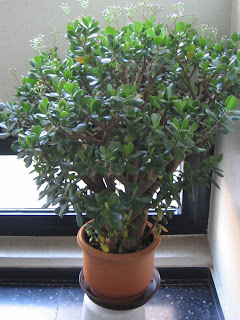
sedum seems to have pulled through, but my lovely, lovely money plant (Crassula ovata) has been frozen to death ...


as has the prickly pear ...


and the mesembrantheum. But at least that saves me having to decide whether to throw it out as I'd been thinking of.


I'm worried to about the aloe. The outer leaves have gone but the centre doesn't look too bad. Will it make it?


I've lost other plants too - the spider plants have been massacred ...


All these are plants which, with due protection, have always overwintered outside without problems. Yet, amazingly, the plants I was most worried about - the annuals that were hardly more than at seedling stage, and the more delicate perennials like my plumbago - all seem to have come through unscathed. I've lost a couple of hollyhocks, but the rest are all there. Even my chrysanthemums - in full bloom when I left. At first sight I thought I'd lost them ...


But look what's happening around the back...


In theory, the coldest period of the year is yet to come - in the next week or so. But fingers crossed that nothing will exceed the pre-Christmas period.

PS : Apologies for the time lapse since the last post. I have been swamped with work. But from now on, things will be back to normal - promise.


Wednesday, June 24, 2009

Talking (sternly) to my mesembryanthemum


Now listen. It's time we had a little talk. How long have we known each other? Five years? More you think? Maybe. And in all that time you haven't given me one single measly flower. Not one.


I didn't blame you the first year. Well, you should know me well enough by now. When have I ever condemned a plant without checking first? And sure enough, all the sites told me you wouldn't flower if you were overwatered. So I cut back. And still nothing. The next year I cut back still further. You just turned brown and tatty.


Now credit where credits due - I've tried hard. I've tried fertilising and not fertilising. I've put you in the sun, out of the sun, half in half out. And still you just sit there. I've pruned you back, I've let you grow, I've taken cuttings. And where did that get me? I now have two of you who won't flower instead of one.


So here we are again. You're supposed to flower from June to August and what have you given me? Not so much as a bud.


Well I'm sorry, but I've had enough. You know I never throw a plant away unless it dies, but I think you're just taking advantage. You're a tatty mess and you refuse to perform. So this is your last chance. I'm afraid you take up too much space for me to be patient any longer. I've checked all the gardening sites I can find, and I'm following their advice to the letter. I've put you in the sunniest spot I can. I'm watering very moderately and you're not getting fertilised if you beg for it. But this is it - you give me some flowers by August or I'm afraid we'll be parting company.


Tuesday, May 20, 2008

Agave or Aloe?

When is an Aloe not an Aloe? When it's an American Aloe, or Agave.

Agaves and Aloes certainly look similar, but despite the fact that Agave americana is often called by the misleading name of American Aloe, the two plants are not actually closely related. The agaves are native to Mexico and the southern states of the US and come from the Agavaceae family, while the Aloes are African in origin and part of the family Asphodelaceae.


Why am I bothered? In my last post I described a plant which I'd seen in Barcelona as an aloe, but in a comment, Blackswamp Girl referred to it as an agave. Which got me wondering if I was right.
After looking at lots of pictures on the net, I think I am. But I can see why the confusion arises. There are agaves which look very similar to this, and aloes which are quite different.
What does anyone else think?


Tuesday, April 15, 2008

Gardener's Bloom Day : Sedum


In Milan, April is the month of sedum and it has to be my choice for this month's gardener's Bloom Day. Stand in any residential area of town, look up and you'll see balconies lined with yellow - sometimes there'll be container after container across whole apartments. It looks great - from below it's just a mass of colour.

But I've always been intrigued about what happens to it afterwards. The flowering period is only two to three weeks. Do the people who fill their balconies with the stuff really only want flowers for a couple of weeks a year? Are they content just to look at the rather boring grey green plant for the rest of the year? Because if your balcony is full of sedum, there's no room for anything else.

Possibly yes. Because if you don't actually like gardening but just want "decoration" on the balcony, sedum is the perfect choice. It must be the least demanding plant that exists, at least in relation to the reward it provides for the albeit brief time it's in flower. Forget to water it for a while? It'll still be there. Brush against it by mistake and break half the stems off? Just stick 'em back in the pot and forget about them. They'll take, and you'll have an even larger display. Which means that you don't have to think about spending money for it. Despite the fact that it's found everywhere here, I've never seen it in a garden centre. Who'd buy it when it's so easy to nick a bit from your neighbour?


I've even seen someone guerilla gardening with it. Near us there's an underground garage, and around the entrance they'd built a low wall, hollow inside and full of earth. But it had never been used. So one day this little old lady arrives with her trowel and all her bits of sedum. And half an hour later, she'd planted a flower bed.


Personally I've only got two pots of the stuff - one small at the front and a larger one at the back. I'm not willing to give it any more space than that, and for much of the year I find myself toying with the idea of getting rid of it all together. But then April comes and I think that well, maybe it's not such a bad plant after all ....

Monday, January 7, 2008

Crassula Ovata


I posted last year about my Crassula Ovata, although at the time I didn't know what it was called. I asked if anyone could identify it for me, and Muppet very kindly did, though by an alternative name Crassula Argentea. I then checked on the net and found that it was supposed to flower at Christmas. Would mine? It hadn't last year, and the net was full of people saying that theirs never had. I found out they would only flower if they had natural conditions of reduced daylight hours - well, mine had been inside all last winter, under artificial lighting. Maybe that was the answer. I decided to risk the cold and leave it outside, though sheltered this year. And the result is in the top photo. Not a whisper of a flower.

So imagine my surprise when I got to Germany for Christmas and found two large specimens in full flower growing in the entrance hall to my sister-in-law's apartment. What, I wondered, was the secret? So when I got back I set about some more research and came up with the site of The Liverpool Branch of the British Cactus and Succulent Society. It's not definitive, just an enthusiast (Jim Mercer) writing about his own experience. But I like it for that.


According to Mr Mercer, various conditions have to be fulfilled if the plants are to flower. Apart from the light conditions mentioned before, he suggests that the plants must be about four years old and a foot tall. Mine is just about that, perhaps a bit less. If that's all though, next year there should definitely be flowers.

He also warns against pruning too late in the year as the flowers form at the end of branches. I didn't prune at all this year, so it's not that, but I shall have to sooner or later. Otherwise they can reach 7ft tall! He suggests June as being the optimum time.

Then there's feeding and watering. C. ovata are dormant in summer, but Mr Mercer advises watering and feeding (reduced strength) weekly. Oddly he doesn't talk about feeding in winter when they're active, but in any case I didn't feed at all this summer. Next summer I'll try it.


I suspect the real reason I'm not getting flowers though, is temperature. Mercer recommends greenhouse conditions in winter, with a night-time minimum of 5°C. And in fact, those in my sister-in-law's apartment block must have just about the same conditions. No way I can do that inside the flat, so next year maybe I should try mine in our hallway too. I can see that I'm going to have to spend 2008 being extremely nice to the neighbours ...

Sunday, October 7, 2007

Hooked on Succulents ...

First of all, thank you to everyone who has sent links for the Garden Bloggers' Retro Carnival. People have sent in some really nice posts, including some with stupendous photos. But don't worry if you're still thinking about it - there's time yet. Just leave me a comment with the link to the post you want to nominate.


The BBC seems to be hooked on succulents at the moment. Every time I go into their Science and nature news site there seems to be an article on some cactus bursting into flower. A couple of days ago I found
this feature about a Hoodia plant, which has flowered for the first time ever at the Eden Project. It's native to South Africa and has always been eaten by bushmen in the Kalahari desert to ward off hunger. Research is currently being done to see if it can be used to fight obesity - hopefully it's not the flowers which they need to use.

But at least at the Eden Project they don't have
the problem caused by an Agave Americana at the University of Wales in Bangor. If you have one yourself, don't plant it in your greenhouse ...

A friend of mine gave me the mother plant of the succulents in the picture (I've forgotten their name). These are cuttings I took a year or so ago. They've grown at a rate of knots, but they haven't flowered yet. Should I be worried?

Sunday, July 8, 2007

Sadly, not my balcony ...


Had a couple of days away last week to see my brother who was on holiday in Liguria. We took a boat ride from Santa Margherita to San Fruttuoso and stopped at Portofino on route. There are some fabulous villas there. I could kill for their bougainvillea ...

The whole area was full of it. Liguria is the area on the north-east coast of Italy, and as you can see from the photos, the coast borders immediately on the mountains - the southernmost part of the Alps. They're very low here - the locals refer to them as hills rather than mountains - and heavily wooded, particularly with chestnut trees. On the coast, the mild Mediterranean climate means that the vegetation is fantastic, with a mix of endemic mediterranean plants, and imported North African and tropical varieties, which flourish. I'd have taken far more photos, particularly of one gorgeous purple flowered vine, which was everywhere - but the batteries in the camera ran out.

Bougainvillea (bougainvillea spectabilis is the most commonly seen) is itself one example of an imported tropical plant, as it comes originally from South America. It was discovered by a botanist, Philibert Commerson, who named it after the captain of the ship he was travelling on - Louis Antoine de Bougainville. Bougainvillea are part of the Nyctaginaceae family, and therefore cousins of mirabilis jalapa, which I've posted about before. The brilliant purple colour comes from the bracts, not from the flowers. They can be grown in pots, but need a lot of sun and dry conditions, and constant warmth - one reason why I've never tried it on the balcony here is because I doubt I could get it through our winters, which are much colder than in Liguria. In colder climates it needs heated greenhouse or conservatory conditions - at least 5°C in winter. One UK grower, David's Exotic Plants, lists varieties which are described as "tough", but unfortunately they don't give details of what they mean by this. How tough is tough? The one on my neighbour's balcony is not doing too well, incidentally. The bracts have lost colour, whereas they should stay vibrant for months. They may have overwatered it, or maybe the red spider mite have hit. Or perhaps they're not feeding it enough - a fertiliser that's high in phosphorus and potassium helps to maintain the colour.

Back to the boat trip. San Fruttuoso is an old monastery nestled at the foot of the mountain ...

Although you can't see it from this picture, just the other side of the landing stage was a load of prickly pear, all in bloom ...

Prickly pear is native to North and South America. I can't work out if this one is opuntia littoralis or opuntia ficus indica - they both look the same to me and both have been imported to and are now common in southern Europe. In Italy however, opuntia ficus indica seems to be most common, and in Sicily and a few other southern regions, is cultivated for it's edible fruit -Fichi d'india, or Indian figs. They're easily available in the shops, though I have to say I've never tried them - perhaps I will now. But the sculptor Bernini must have liked them - he sculpted them into his Fountain of the Four Rivers in Piazza Navona in Rome.